The Cosmetic Bag Measures Correctly. Why Does the Set Not Fit?
Check the opening, usable interior and packing sequence before enlarging the bag. A fit review for brands developing a cosmetic pouch or case around a fixed set.
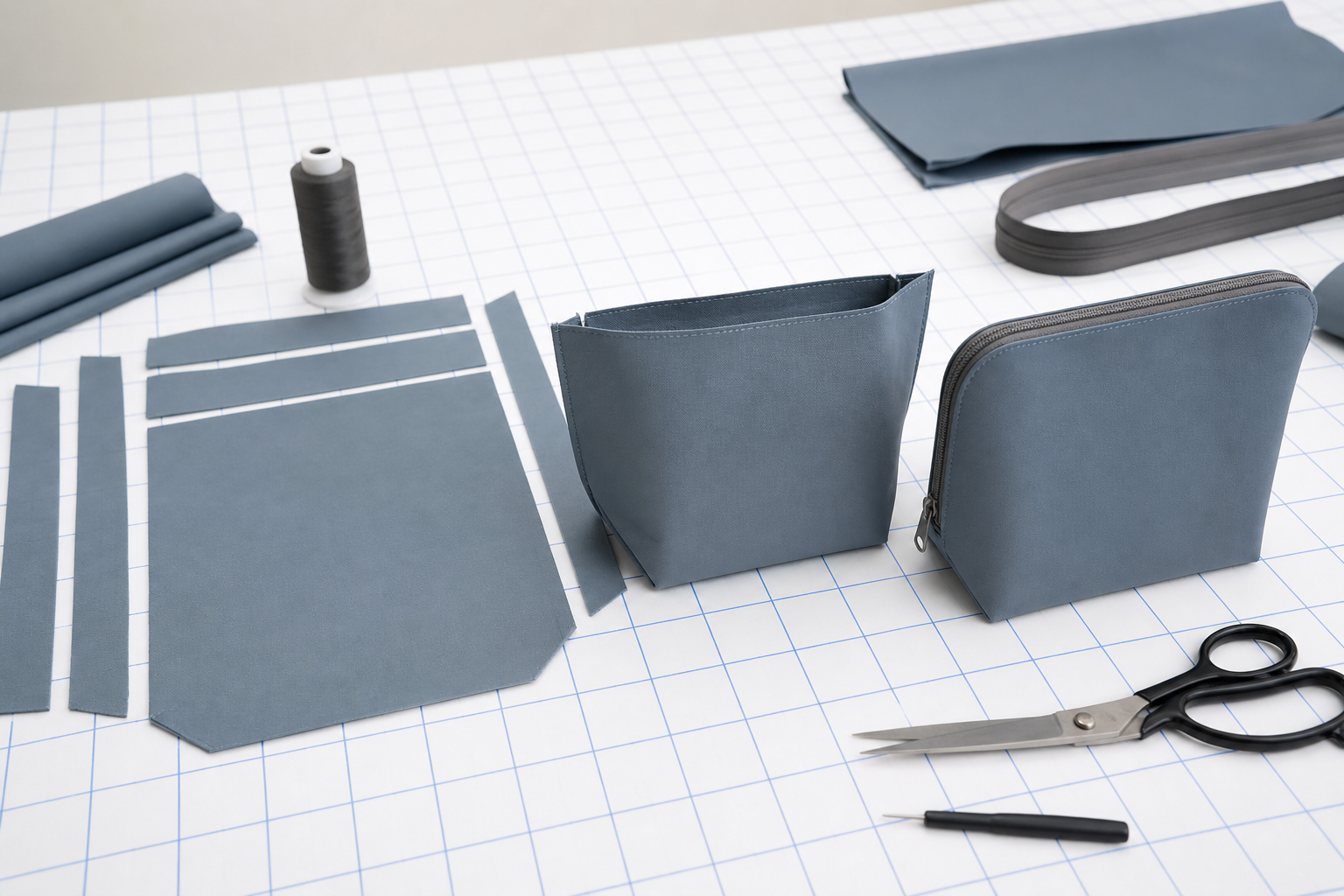
Your team approves the dimensions of a cosmetic bag, but the intended set will not pack neatly into the sample. Making the whole bag larger might solve it. It might also leave more unused space while the widest palette still catches at the opening.
Before changing the outer dimensions, check three things separately: whether each item can enter, whether the complete set can sit in its intended arrangement, and whether the filled bag closes normally. Those checks tell the sample maker where a revision is needed.
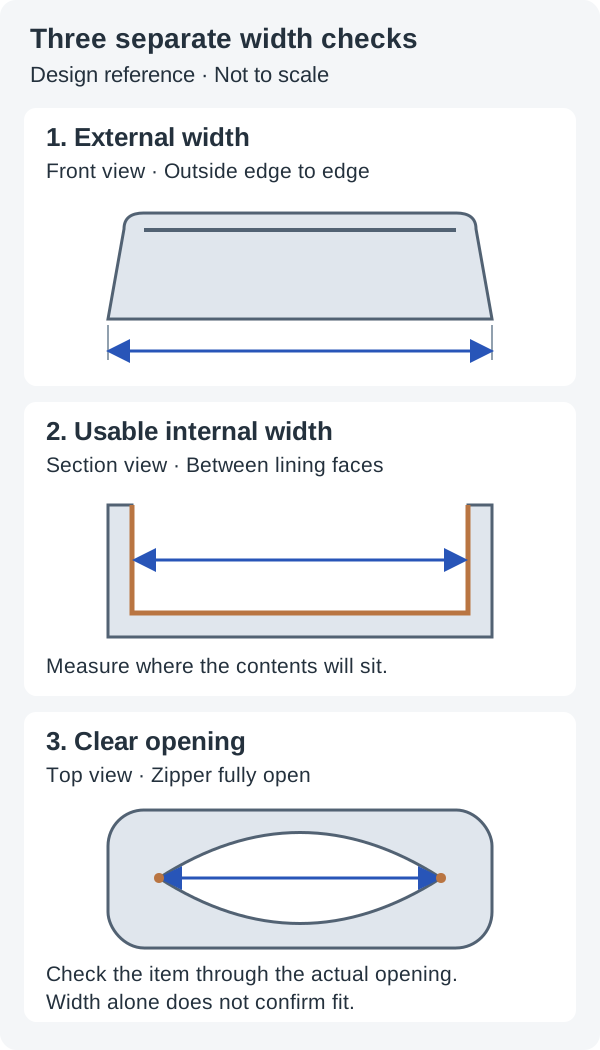
The drawing separates three measurements that are easy to confuse. External width describes the outside of the bag. Usable internal width is measured between the finished lining faces at the level occupied by the contents. Clear opening is the space available for an item to enter with the zipper fully open. Record the measurement points on a photograph of your sample; these widths alone do not confirm fit.
Use the diagram to name the problem, not to calculate an internal size by subtracting a standard allowance. This guide does not prescribe a universal extra clearance. Measure the finished sample and agree any required working space around the actual set with the sample maker.
Freeze the contents for this sample round
Set out the exact bottles, palettes, brushes and accessories that belong in the bag. Include caps, pumps, sleeves and any packaging that will remain around them. A bottle measured without its cap is not a useful height reference if it will be packed with the cap on.
Give each item an identifier and photograph the full set. Record the outside dimensions and the required quantity of each item. Note whether it must stand upright, lie flat or remain in a particular pocket. If the packaging is still changing, identify the unresolved item rather than approving fit against an old container without a note.
| Contents-list field | Record before the fit review |
|---|---|
| Item and revision | Container or accessory identifier, including packaging version |
| Quantity | Number required in the complete set |
| Outside dimensions | Units and measurement points, with cap or sleeve fitted |
| Intended position | Upright, flat or in a specified compartment |
| Status | Actual item supplied, stand-in used or final size still open |
Keep different kit configurations separate. If one bag must serve two sets, check both sets and name them in the approval. Passing with the smaller set does not establish fit for the larger one.
Sending the actual set gives the sample team the clearest reference. When that is not possible, provide dimensioned drawings and discuss suitable stand-ins. A simple block can help check an envelope, but it cannot reproduce every curved shoulder, flexible tube or moving pump. Keep those limitations on the review sheet until the real items are available.
Measure the route into the bag
Open the sample as it would be opened during packing. Try the widest and tallest items separately before arranging the whole set. Watch where an item stops: at the zipper ends, at a curved corner, against a divider, or inside the main compartment.
Photograph the item where it stops, then mark the two contact points on a photograph of the empty bag. That shows the sample maker which part needs attention. “Make the bag roomier” leaves them guessing whether to change the opening or the body.
An item that enters diagonally may still be practical, but decide whether that packing step is acceptable. If the packer must bend the item, force the slider or remove another required component first, record it as an unresolved fit issue. Do not count a forced insertion as approval.
Check the finished interior with the whole set
Measure the assembled space where the contents actually sit. The outside width does not describe every internal level of a shaped bag. The space at the base, beside a pocket and under the closed lid can differ.
Pack the complete set in the required arrangement. Check the pockets while the main compartment is occupied; an empty pocket may appear usable until the neighboring bottle presses against it. Review any lid storage with the lid closed, since items attached to it also occupy space inside the bag.
| What happens during packing | What to record | Revision to discuss |
|---|---|---|
| One item stops at the entrance | Contact points and item orientation | Opening shape or zipper end position |
| Items enter separately but not together | A photograph of the complete layout | Compartment width or arrangement |
| The lid presses on a cap or brush | The contact area with the set loaded | Usable height or lid organization |
| A required pocket cannot be accessed | Which neighboring item blocks it | Pocket position or opening direction |
| The closure distorts when loaded | Where the body or zipper is pulled out of shape | Packing layout, support or dimensions |
These are questions for the next sample, not instructions to change every feature at once. Agree which adjustment the sample maker will try and which parts of the brief stay fixed.
For example, imagine a palette that sits comfortably inside the bag once inserted diagonally, but catches at the zipper ends when inserted flat. This hypothetical case points to an entry problem rather than insufficient space around the packed palette. First decide whether diagonal insertion is acceptable for the intended packing process. If it is not, discuss the opening with the sample maker before increasing every dimension.
Review packing and removal as separate tasks
Write down the packing order that worked. Then ask another person to follow it using only the sheet and the contents list. If they need an explanation that is missing from the sheet, improve the instruction or reconsider the arrangement.
Next, take out the item that needs the most frequent access. Note whether other items must be removed first and whether the contents stay in position while the bag is open. A tightly arranged set may be acceptable for one program and inconvenient for another. Make that decision against the intended use, rather than assuming maximum fill is always the objective.
For a brand developing several bag formats, compare the cosmetic bag range before deciding which construction to adapt. A flat cosmetic pouch and a structured makeup case provide different starting arrangements. Their listed reference dimensions are not a promise that your particular set will fit.
Approve a recorded combination
Keep a short fit record with the accepted sample. These fields make it possible to repeat the same check when the next revision arrives:
| Field | What to enter |
|---|---|
| Sample and contents | Sample revision, contents-list revision and item quantities |
| Measurement points | Photograph references and units used for the opening and interior |
| Arrangement | Loaded photograph and any required item orientation |
| Packing and access | Packing order and the item checked for routine removal |
| Closure | Whether the filled bag closes normally; photograph any distortion |
| Decision | Reviewer, date, accepted arrangement or issue still requiring a new sample |
A changed bottle or divider needs a new fit check at the affected location. Keep the earlier record, but do not apply its approval to a combination that has not been checked.
An unresolved fit record should name the obstruction and the next review needed. For example: “Opening revision pending; recheck palette P with the full set after the next sample arrives.” This is an illustrative instruction, not an actual test result. It keeps a general “approved” message from closing a decision that remains open.
This review establishes whether the agreed contents fit and can be handled as intended. It does not establish drop protection, spill containment or other performance claims; those need their own requirements and verification. Use the broader bag sample review guide for construction, appearance and approval records beyond fit.
Once fit is accepted, document separately how the bag or complete kit will be prepared for delivery. The carton assortment guide helps keep different bag and kit versions identifiable during packing.
To discuss a custom cosmetic bag with Truedrape, send the contents list, container dimensions and preferred arrangement. If you already have a sample that does not fit, include photographs of the exact point where packing or closure fails.